


Osteoarthritis of the knee joint combines two processes: the destruction of cartilage and the growth of osteophytes or bone spurs.The stage of the process is determined by radiography.It is considered that arthrosis is the destruction of the knee joints with age, a natural process of aging.The reasons are muscle weakening and poor blood supply to tissues.How to treat without surgery?Eliminate factors that reduce muscle tone.
Causes
The causes of arthrosis have not yet been determined by medicine,Only risk factors are named:age over 45, knee injuries and overweight.Almost 50% of the adult population has ever complained about the knee joint.
In arthrosis, the cartilage lining the edges of the bones wears away or is completely absent.Damaged tissue is not a source of pain because it has no receptors.Inflammation in nearby structures causes characteristic symptoms.
The body continues to regenerate the damaged tissue, but the cartilage grows unevenly.As a result, irregularities are formed that injure other elements of the joint.The nature of osteophytes is explained by the compensation of smooth articular cartilage.Another version suggests that the expansion of the Spursassociated with an attempt to stabilize the joint medially or laterally due to muscle weakness.
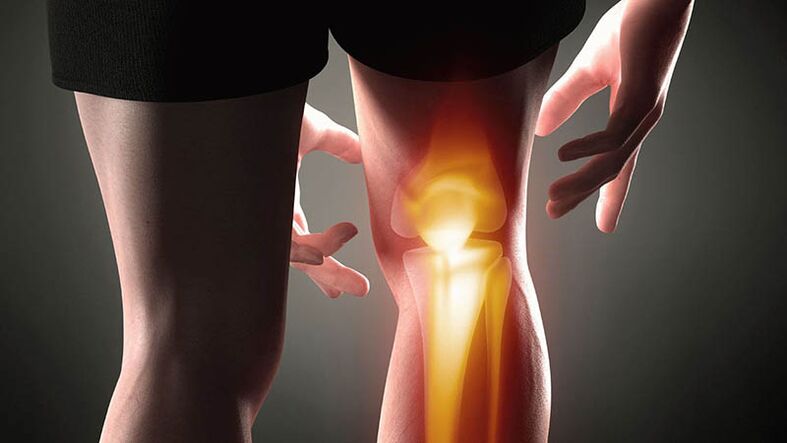
What causes chronic osteoarthritis of the knee joint?Pain occurs in tendons and ligaments only when muscle forces no longer hold and control the bones.Therefore, the biomechanical causes of pain and arthrosis differ:
- On the background of prolonged sittingCompression occurs between the inguinal ligament and the iliopsoas muscle of the femoral artery and nerve, which weakens the strength of the front part of the thigh and leads to tension in the tendon - below the knee.
- Prolonged sitting strains the gluteal muscles, weakening them.Instead, the piriformis muscles begin to work under which the sciatic nerve passes.When squeezed, the biceps muscle is weakened, and the angle of rotation of the thigh and lower leg changes.The knee is injured.
- Walking in heelscauses tension in the calf muscles, rotates the pelvis and weakens the gluteal muscles.The femur rotates inward, the ligaments along the inside of the knee and the medial meniscus are stressed, and osteophytes grow.
- Flat feet, associated with wearing uncomfortable footwear, weakening of the adductor muscles and increased lordosis, rotates the tibia outward, leading to knee pain due to disturbed biomechanics and the development of Baker's cyst.
Pathological chains affecting the knee are associated with falling on the coccyx in childhood, scoliosis caused by diseases of internal organs.People with different shoulder heightsover time they begin to complain about the knee, since the fascial chains along the front part of the body include the extensor of this joint - the rectus femoris muscle.
Symptoms
The degenerative process impairs joint function, leading to pain and stiffness.It is believed to beaction on muscles begins with cartilage and bone.Practice shows the opposite -pain in the knee joint occurs in the tendons- joins weakened extensor, flexor and stabilizer muscles of the knee.
The main danger signs of cartilage wear:
- Occasional discomfort associated with walking, a feeling that you "put your foot in the wrong place".
- The appearance of pain during direct loading of the joint and the muscles that bend and extend it - squatting, climbing stairs.
- Knee pain and stiffness after prolonged inactivity or rest, for example, when getting out of bed in the morning, which is associated with venous blood stagnation.
The main signs of arthrosis are caused by stress on weakened muscles:
- Pain in the knee when standing up is due to the fact that the gluteus and biceps hip extensor muscles do not work, and the rectus femoris muscle is excessively stretched, creating discomfort in the knee.
- Pain when bending the joint is associated with weakness of the flexor - biceps muscle and tension in the quadriceps tendon.
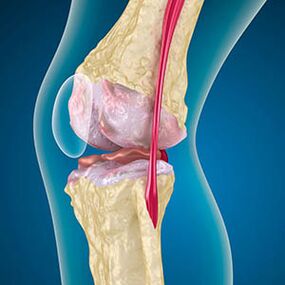
Swelling is caused by soft tissue injury, inflammation of tendons and joint capsule.The appearance of heat in the knee area, swelling, indicates the accumulation of inflammatory exudate -Arthrosis is often accompanied by bursitis, synovitis and tendonitis.
Cracking in the knee can be painless or traumatic.Cracking and other sounds do not indicate that the bones are worn.Signs of knee instability -weakness of one of the muscles that controls movement.
Crepitus, caused by bone-to-bone friction, does not occur at the beginning and end of the range of motion, but in the middle,even with passive flexion of the wrist.Joint locking is caused by wear and tear on the cartilage and tendons, which creates a feeling of being locked in place.The bones are controlled by the muscles during every movement.Their untimely contraction leads to a change in the direction of bone movement, blocking.
1st degree
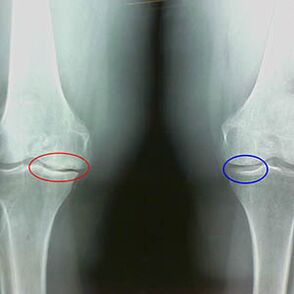
The degree of arthrosis is determined by X-ray, revealing the participation of bone structures in the pathological process.Their change indicates that the muscular system has been out of balance for 5-10 years.As a rule, peoplehave been experiencing excruciating pain for several years.
In the first stage of arthrosis, which is accidentally discovered, there is a slight growth of bone spurs.Growths appear in places where the joint is most unstable.Usually, patients rarely experience pain or discomfort during movement.
The weakness of some muscles is compensated by the function of others, without causing severe spasms and overload.Running and weight training cause symptoms by straining weakened muscles.Muscle weakness (hypotonia) is associated with impaired blood supply and innervation.
2 degrees
The second stage of arthrosis is considered mild.X-rays reveal significant bone spurs, but the cartilage is unaffected.The amount of synovial fluid decreases, but there are symptoms of pain after long walking and running, joint stiffness and pain when bending and kneeling.
Early radiological signs of the second stage of knee arthrosis:
- the pointed edges of the intercondylar tubercles on the tibia, where the cruciate ligament is attached;
- narrowing of the joint space on the medial side;
- pointed edges of the condyles of the bones on the medial side, less often on the side - depending on the development of valgus or varus deformity of the joint.
For the second phase according to Larsencharacterized by narrowing of the joint space by more than 50%, but this can only be verified in dynamics or in comparison with an unaffected joint.
3 degrees
In the third stage of arthrosispain when bending and straightening the joint becomes constant.During an exacerbation, the joint turns red and swells, and the pain does not stop even at rest.Swelling and noticeable deformation of the contours of the joint appear around the knee.
Signs of moderate arthrosis of the knee joint in the third stage:
- the joint space is significantly narrowed;
- the presence of subchondral sclerosis in the affected areas;
- numerous osteophytes on the edges;
- rare occurrence of subchondral cysts;
- synovitis, occurrence of Baker's cyst below the knee;
- uneven surfaces of the femur and tibia, loss of joint congruence;
- change in the shape of the patella;
- foci of calcification and chondromalacia;
Rarely, the fourth stage is supplemented by necrotic lesions.Why is arthrosis dangerous?The disease impairs the ability to move and creates dependence on others.
Diagnostics
The podiatrist examines for signs of swelling, palpates the joint for tenderness, and examines active and passive range of motion.Be sure to examine the lumbar spine, becauseThis is where the nerves that provide function to the thigh muscles pass.
An X-ray shows the presence of osteophytes, a change in the space between the femur and tibia, which indicates loss of cartilage in the knee.Sometimes X-rays of knee joints show significant signs of cartilage wear, but patients do not feel significant pain.On the contrary, arthrosis of the first stage can impair the function of the knee, because the cause of the pain is hypotonic muscles.
If the x-ray shows no major changes, thenthe doctor prescribes magnetic resonance imaging of the knee joint and lumbar region.Diagnostics visualizes ligaments, tendons and muscles, and menisci to look for other sources of pain.
Laboratory diagnosis is essentialif you suspect a joint infection or gout.
Treatment
Arthrosis therapy must be comprehensivedirected at the cause of the disease.Appropriate treatment is carried out for endocrine dysfunctions that can affect the connective tissue.Overweight patients are recommendedswitch to a proper diet.Exacerbations are alleviated with medication.
Drug treatment
Treatment of pain with drugs includesprescribing anti-inflammatory drugs.Nonsteroidal anti-inflammatory drugs for long-term usenegatively affect the function of the stomach.
The treatment regimen includes chondroprotectors, which help only if taken in long courses3-6 months.Pharmacies offer a large number of medicines from this group.
It is believed that the components of these drugs help in the regeneration of the cartilage structure and have an analgesic effect.
There have been few controlled studies, and they concerned complex treatment - arthroplasty, physiotherapy, diet.
Attention!Chondroprotectors are taken in courses - you can take one course of one drug and another course of another and compare the effect.However, uncontrolled use of medication is not a good idea.Before you start taking medicines, consult your doctor.
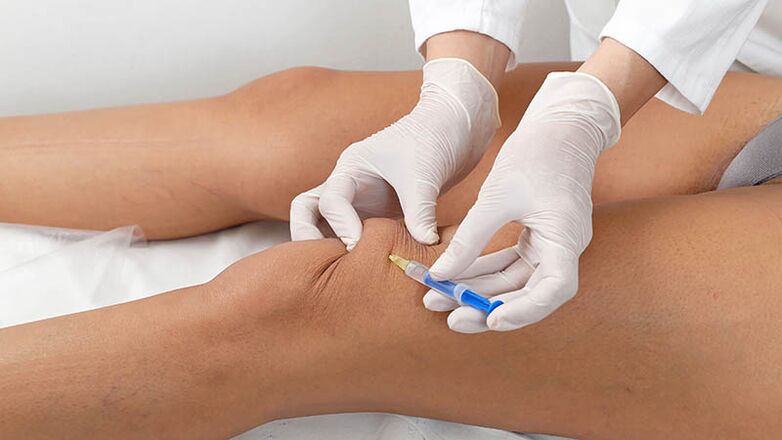
How and with what to relieve pain and swelling?Intra-articular injections are more popular:
- Steroid drugsthey suppress inflammatory reactions at the level of immune cells, relieve acute pain, joint stiffness and swelling.
- Hyaluronic acidincreases the viscosity of joint fluid, reducing the friction of joint surfaces.
Important!The effect of the drugs lasts 6-12 months, but the degenerative processes do not stop.
Surgical treatment
If the drugs are poorly effective, patients are offered arthroscopy– a minimally invasive procedure for the removal of bony growths and joint revision.If necessary, surgeons perform plastic surgery on ligaments and cartilage, and remove areas of worn tissue.
Bone osteotomy aims to change the load axis on the joint.The doctor cuts the femur or tibia to change where the joint surfaces meet.The operation is often performed on young patients.
Total knee replacement or arthroplastynecessary for severe stages of arthrosis (third or fourth degree).Surgical treatment does not always solve the problem, as it requires diligent and daily rehabilitation and muscle strengthening.
Changes in the knee can be compensatory in relation to the pelvis, therefore, without establishing muscle balance, the hip joint suffers next.
Physiotherapy treatment
Mud applications, phonophoresis and magnetotherapy are used in the physiotherapy environment.The action of external factors is targetedstimulation of blood supply and tissue regeneration, relief of inflammation and swelling.
Treatment with traditional and non-traditional methods
Recipes for folk remedies for the treatment of arthrosis of the knee joints at home are usuallyaimed at reducing swelling and relieving pain.Most often, horseradish leaves and potato pulp are used, sometimes honey and vodka are mixed for dressings.
Degeneration cannot be completely stopped.You can influence the metabolism of the kidneys with celery juice.The kidneys are associated with the iliopsoas muscle, which is associated with hip pathologies.Normalizing the function of the gallbladder and liver improves the condition of the knees.
Traditional medicine methods for treating the initial stage of knee arthrosis include decoctions of anti-inflammatory herbs:chamomile, St. John's wort, immortelle.Rubs made from dry mustard, sea salt and kerosene are used.Baths with magnesium salts and pine infusions are used.
Manual therapy and massage
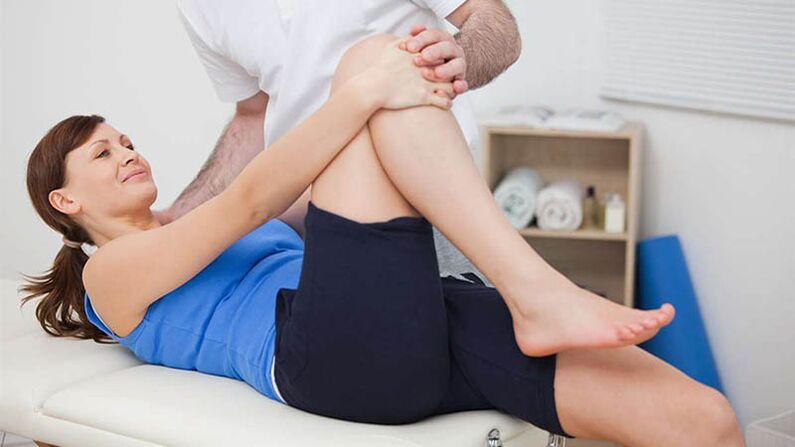
Manual therapy for osteoarthritis of the knee joint helps, if the specialist understands muscle tone imbalances.Muscle tests help find weakened muscles that stabilize the knee, determine the cause of the dysfunction, and correct it.
The source can be not only the joint block in the lumbar region,but also dysfunction at the level of blood supply, internal organs, endocrine and biochemical disruptions.Therefore, a chiropractor must have the skills of osteopathy and applied kinesiology in order to influence many factors.
Massage acts as an auxiliary tool for manual therapy and self-help.A patient with arthrosis of the knee joint can independently stretch the tendons of the muscles that control the movement of the limb:
- the area around the gluteus maximus muscle;
- lines along the front surface of the thigh - from the pelvis to the patella;
- lateral surface of the thigh from the greater trochanter to the femoral condyles;
- groin area along the inguinal ligament;
- the inner surface of the thigh (along the line of the adductor canal).
The massage is performed with acupressure, without much pressure.
Therapeutic gymnastics
The cause of arthrosis is weakening of muscles caused by problems in the lower back, pelvis, and abdominal cavity.Perform exercises to prevent arthritis and arthrosis of the knee joints for older peopleIt can be used to increase strength, but not tone.
Without working on the factors that weaken them with the help of manual therapy, it is difficult to achieve a complete restoration of biomechanics.Yoga additionally deprives the joints of stability.Among the treatment methods, it is better to preferPilates and Nordic walking.
Diet
Nutrition is adjusted primarily to combat excess weight.It is important to give up sugar and simple carbohydrates, add foods with fiber, magnesium, B vitamins and calcium for knee osteoarthritis, which are important for muscle activity.Try itcut out dairy products, since almost 80% of the population is lactose intolerant.
Prevention of arthrosis of knee joints

Trying to strengthen muscles through exercise doesn't always help., because innervation and blood supply have not been restored.The function of the thigh muscles depends on the lumbar plexus.
Changes in the lower back associated with weak abdominal muscles also affect the knees.Therefore, arthrosis is more common in men with a "beer belly", as well as in women after polyhydramnios, several childbirths with diastasis - weakening of the muscles of the abdominal wall.
Surgeries in the area of the pelvis and internal organs create adhesions that affect the lumbar vertebrae, disrupting the innervation of the muscles around the knee.
Which doctor should I consult for osteoarthritis of the knee joint?An orthopedist will help with the diagnosis, who will insist on the operation.The best results are achieved by the work of multidisciplinary teams in rehabilitation centers.
The best thing you can do for your joints:eat right, watch your weight, walk more, visit a massage therapist or osteopath once every three months.
Treatment reviews
Positive reviews can only be given by comprehensive treatment of deforming arthrosis of the knee joint or gonarthrosis.Anesthesia and intra-articular injections work temporarily, suppressing the natural inflammatory response.
Conclusion
The problem with arthrosis is that drug therapy temporarily eliminates only painful syndromes.The reasons remain unidentified and unaffected.Occupational therapists can help by teaching you how to live with knee osteoarthritis and how to use a cane properly.But the service is available only in private clinics that provide rehabilitation.